CarForms.co.uk checks, prints and posts your V62 to the DVLA for you.
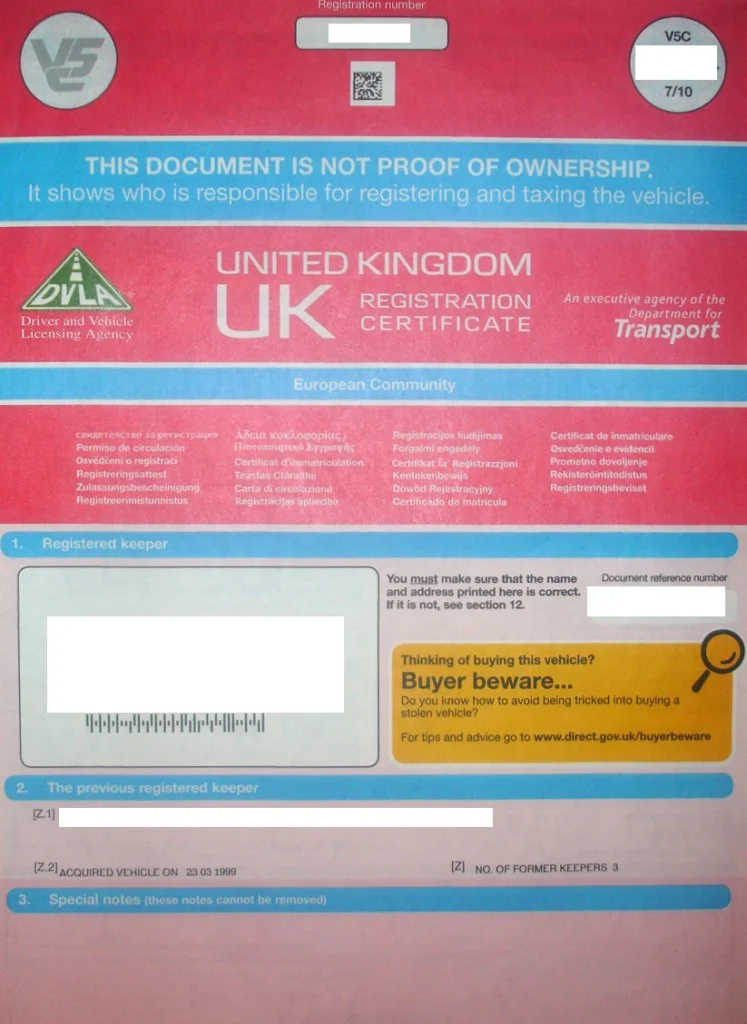
Replace my V5C →The V5C logbook is the DVLA vehicle registration certificate for a vehicle. It records the vehicle’s identifying details and the name and address of its registered keeper. It is important for buying, selling and updating a vehicle, but it is not proof of ownership.
The paperwork can look confusing because the certificate has several information panels and detachable slips. This guide explains what the main sections mean, what to check and what to do if your V5C is missing or out of date. For the wider picture, start with our V5C logbook guide home.
The Driver and Vehicle Licensing Agency (DVLA) issues a V5C to record a vehicle on its register and identify its registered keeper. The keeper is the person or organisation recorded as responsible for the vehicle’s registration details. A V5C is not a certificate of title and does not establish who legally owns the vehicle.
The certificate is used to keep the DVLA record current when a vehicle changes keeper or when relevant details change. You may also need information from it when taxing a vehicle, checking paperwork or applying for a replacement. GOV.UK’s vehicle log book guidance explains the official processes.
The document combines information about the vehicle, the keeper and the certificate itself. The exact layout and wording can differ between editions, so use the printed headings rather than relying only on a section number.
| Part of the record | What to look for | Why it matters |
|---|---|---|
| Vehicle identity | Registration mark, make, model or type, and VIN or chassis number | Helps confirm the document belongs to the vehicle |
| Technical details | Colour, fuel type, engine capacity and other listed specifications | These should be consistent with the vehicle and its records |
| Registration history | First registration date, manufacture details where shown, and keeper-change information | Gives context, but is not a full ownership or service history |
| Registered keeper | Keeper name and address, plus the relevant date | Shows who DVLA currently records as keeper |
| Certificate information | Issue date and an 11-digit document reference number | Used for certain DVLA transactions; keep it secure |
Not every field applies to every vehicle. Imported, modified, older or specialist vehicles may have different entries or additional notes. The V5C is not a substitute for an MOT history, service record, finance check or physical inspection.
 Person holding a red vehicle registration document next to a set of car keys.
Read each panel against its heading. Some versions arrange the information differently, but the purpose of the main areas is broadly the same.
The V5C also has an 11-digit document reference number. Treat it as private paperwork: do not publish a clear photograph of the certificate, and only provide the number when you are completing a legitimate DVLA process.
No. The registered keeper is the person recorded by DVLA. The owner is the person or organisation with the legal ownership interest, which could be different, for example where a vehicle is leased, financed, used as a company car or kept by someone on behalf of another person.
This distinction matters when buying. The name on the V5C should make sense in the circumstances, but it is not enough on its own to prove the seller has the right to sell the vehicle. Check the vehicle identity and paperwork, ask reasonable questions about the seller’s authority, and use other checks where appropriate. You can also use our registered keeper check tool to understand what a keeper check can and cannot tell you.
The certificate is the main DVLA record document. Detachable sections are intended for particular transactions, so do not remove or send a slip unless its printed instructions apply to what you are doing.
| Document or slip | Typical purpose | Practical point |
|---|---|---|
| Main V5C | Records vehicle and registered keeper details | Keep it safe and update DVLA when necessary |
| V5C/2, green slip | Given to a new keeper after a sale or transfer | Keep it and follow its instructions while waiting for the replacement certificate |
| Other transaction panels or slips | Used for the specific notification described on the document | Check the current printed instructions, as formats and processes can change |
A buyer should receive the new keeper slip, not simply take the seller’s entire V5C as if that alone completes the transfer. The official new keeper guidance sets out the current steps. Our V5C vs V62 difference guide explains why a V62 is an application form, not a replacement logbook section.
 A red vehicle registration document and a separate application form on a desk with car keys and a pen.
Use the certificate as one part of your checks, not as a guarantee that a vehicle is genuine or free of problems. Compare the registration mark and VIN with the vehicle, check that the seller’s explanation of the keeper details makes sense, and look for alterations, damage or missing pages and slips.
Before paying, consider these practical checks:
A seller who cannot provide a V5C may have a legitimate reason, but you should resolve the situation before completing the purchase. For official selling steps, see GOV.UK’s vehicle sale guidance.
Tell DVLA when the keeper or relevant vehicle details change. The method depends on the change. For example, use the process specified for a keeper transfer, and follow the separate instructions for a name or address change. GOV.UK provides the current change of address process. Keep a copy of any application details until the updated document arrives.
If the V5C is lost, stolen, damaged or has not arrived, first check whether the keeper details or application are still being processed. If you need a replacement and cannot use an eligible online service, form V62 is the paper application. The known V62 fee is £25, and DVLA says to allow up to four weeks. Check GOV.UK for the current fee and eligibility before applying, as rules can change. See our guides to lost V5C replacement and getting a duplicate V5C.
CarForms.co.uk can complete, check and post a V62 for a fee if you would prefer help with the paperwork. Its stated customer average is about 19 days, which is an average rather than a guaranteed delivery time. You can also read our guide to how long a V5C takes for more on waiting times.
Keep the certificate secure, check its details when it arrives and tell DVLA about relevant changes promptly. If a document, vehicle or transaction does not match the instructions, do not guess which slip to use. Check the current DVLA guidance or explore our all V5C guides before sending paperwork.
CarForms.co.uk checks, prints and posts your V62 to the DVLA for you.
Replace my V5C →No. It identifies the registered keeper recorded by DVLA. Ownership may belong to a different person or organisation.
The V5C document reference number is 11 digits. Keep it secure because it can be used in some DVLA processes.
The V5C/2 green slip is the new keeper supplement. The seller gives it to the buyer, who should follow the instructions printed on it.
A V62 paper application costs £25, and DVLA advises allowing up to four weeks. Check GOV.UK for the current fee and application options.
Yes. The V5C records the registered keeper, which may be different from the legal owner, such as with a leased or company vehicle.